Be it long or short, the train began pulling into Lao Cai city. We didn't really know what time it was supposed to arrive, so we woke up around 5-6 in the morning.
Lao Cai is located in the north, next to it is the resort town of Sa Pa, which is where we were heading. We wanted to go there because nearby is Vietnam's highest mountain — Fansipan, 3143 meters high. We were planning to climb it. The Brits from the next compartment, on the other hand, weren't aiming that high; they were just going to wander around the area.
Vietnam, day 1 : Lao Cai to SaPa
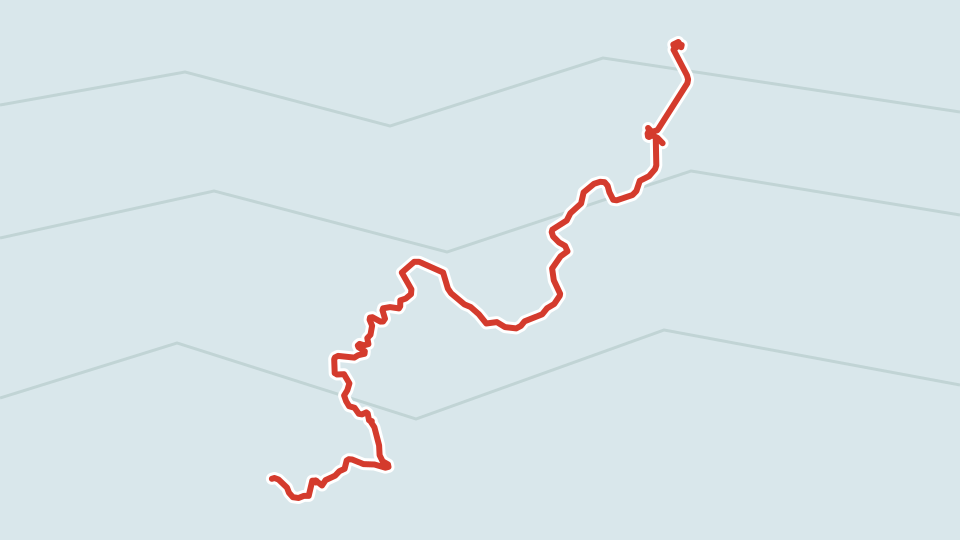
EveryTrail - Find the best hikes in California and beyond
Google, by the way, doesn't want to import gpx from Vietnam, apparently communism is not to its liking.
I haven't finished coding my own super-system with a map and photos yet, I ran into a complex problem, and well, there's absolutely no time.

When I looked out the window, the landscapes immediately took my breath away, and didn't let go for a long time
Many Vietnamese passengers, by the way, didn't even go to sleep — they sat on the bottom bunk in a crowd and socialized.

Even these first pictures caused wild delight
It faded later on, of course, but it was still nice.

"Vietnamese cows and a peasant woman"
You can't see it here, but Vietnamese cows have long horns, sometimes even so long that they are curled. Also, the cows are phlegmatic and look healthy. Sometimes kids ride them, and even adults do. Here it must be said that the Vietnamese are on average a head shorter than a regular European. I'm 1.78m and was already taller than everyone, and if you are, say, 1.87m — you're a real giant to them. The physique of the Vietnamese is slender; you only see fat ones in big cities. This is understandable — they eat naturally, vegetables and rice; judging by everything, they eat little packaged and processed foods (but more on that later).

A river
Our bicycles made it almost without incident, except for the fact that someone spat on them. Unpleasant, but it's one of the few instances of unfriendliness that I can recall.

Lao Cai
We arrived early in the morning, around 7 o'clock, and set off half an hour later.

There are many electrical poles in Vietnam, and even more wires
In Vietnam, they don't stress over many things at all — wires sticking out everywhere and hanging here and there don't bother anyone. It might ruin the panorama, but it creates local flavor. Of course, it doesn't get as crazy with the wires as what Tema Lebedev shoots in Africa, but overall it's quite something. Things are still not completely fine with electricity; in the flimsiest shacks, they apparently don't have it.

There are a lot of rivers and mountains in the north of Vietnam, you can admire them for a long time

Of course, it's always foggy in Vietnam, which anyone who has seen photos from there knows

The road from Lao Cai to Sa Pa is very steep
Pay attention to the concrete post with the red top on the left. It's a signpost to the big cities. There are no traditional road signs with distances in Vietnam, like we have.

A hut, you could probably even spend the night in one of these
Running ahead, I'll say that in Vietnam they treat things simply, and so there shouldn't be any problems spending the night in such a hut, except that they might show a lot of interest.

Here the incline is actually a little visible

The views are beautiful, albeit foggy

The ever-present wires and rice terraces

Gathering greens, apparently

A typical Vietnamese sign
There are a lot of these, because the turns are sharp everywhere. The sign is yellow, with a red border, the arrow is sharply bent. The signs are all old and unsightly, and even when it was new, judging by the paint drips, it was painted carelessly. This is the norm in Vietnam — as long as the process is moving somehow, the details aren't that important. In principle, not a bad approach — saves you from fraying your nerves with European perfectionism.

Hoses for hosing down trucks with water
A few words about the weather. There are rainy seasons in Vietnam, but they depend on the region, just like the weather in general. In the north where we were, if I'm not mistaken, it's worse in summer and winter, and better in spring and autumn. It's driest in autumn. In any case, it's almost always hot (20 and above during the day, if you aren't too high in the mountains), plus very humid and stuffy. Water flows down from the mountains, and it's used to hose down trucks, which, strangely enough, they do have in Vietnam — not everything is transported on motorbikes. Although they can transport everything on them — you'll see this for yourself later.

There are dogs in Vietnam, cats are fewer
Do they eat dogs in Vietnam? A burning question, but the answer won't be coming soon, in the middle or maybe even at the end.

The hoses are connected to the mountain water pipe high up, so there's pressure

Chicken is, as they say, ubiquitous

The fog gets foggier

In the hut, you could probably wait out bad weather and cook yourself some grub over the fire

This is us buying cucumbers
The cucumbers cost 36 santims for 6 pieces. Water and sodas, by the way, cost about half a dollar per bottle or can, the size and type of drink mattering little. Next to the cucumbers they sell chickens, which usually sit in cramped cages. This is necessary because the cages are transported on motorbikes, just like everything else. As you can see, the saleswoman is wearing a "vietnamka" hat. This is a perfectly normal village headpiece, not a tourist souvenir at all.

It's hard pedaling uphill, very much so

Socialist realism

Streams, rocks, greenery everywhere. Very beautiful.

We couldn't handle the hilliness on the first day
When we had cycled about 15 km (according to my GPS, although my comrades say it was 20), a semi-scheduled Lao Cai - Sa Pa minibus drove past us. The guy and girl inside waited unhurriedly while we decided whether we had tortured ourselves enough on the mountain roads for today, and whether we wanted to ride the rest of the way in comfort.
If I had known how things would turn out later, I might not have given in to the provocation to betray my touring ideals, but at that point I decided that the main thing for me was to see Vietnam, and not to show off my strength and skills in forcing my way up climbs, so I completely agreed with my comrades to take the minibus to Sa Pa. They charged us about 10 dollars for the three of us, but only because the bus was heading to Sa Pa anyway.

Anna's pannier bag
In my opinion, the design is not so great. The bag is bulky, sits insecurely on the bike (at least on Anya's), it's heavy to carry, and unfastening and fastening it takes time. The bag is sewn according to the design of bags from the Pik-99 company (I think), but turned out worse, lacking useful nuances.
The classic waterproof Ortlieb panniers for bike tourers that Intars and I used (and which I bought right before the trip, something I don't regret at all) seem more convenient to me.

All three bikes fit
Whether more than three would have fit is another question. So we were lucky here, we always managed to cram three in everywhere.

The terraces stretch on and on

And at the foot they're there too

Views

A pastoral scene, hehe
Here our transporters deliberately stopped and offered to let us take a photo. Like, it's very beautiful. And you really can't argue with that.
